
Why Every Business Needs a Website: The Ultimate Growth Engine
Statistics show roughly 81% to 87% of modern shoppers research products and services online before buying, with 93% utilizing online reviews and 99.5% doing so at least sometimes.
📌Shopping and Search Habits:
🔶81% of consumers extensively research major products and services online before visiting a physical store or making a purchase.
🔶87% of shoppers research their purchases online regularly or always, with 99.5% doing so at least sometimes.
🔶33% of American shoppers begin their buying journey directly with general online search engines, while 50% start their product searches on Amazon.
🎯Reviews and Decision Making:
🔷93% of consumers look at online reviews to guide their final purchasing choices.
🔷82% of U.S. adults read online customer ratings at least sometimes before trying something new.
🔷55% of U.S. adults watch online video reviews to help inform their decisions.
📢These metrics tell us why every business needs a website.
If you are running a business—whether you operate a medical clinic, a dental practice, a retail storefront, or a B2B enterprise—relying solely on social media pages is no longer enough. In today’s global digital-first economy across the USA, UK, Canada, Australia, and the EU, a professional website is no longer a luxury asset; it is the fundamental anchor of your brand.
If your prospective clients search for your offerings and cannot find a polished, authoritative digital home, they will move on to someone else.
Table of Content
ToggleThe Hidden Cost of Not Having a Website😢
You’re Losing This Much Market Share Right Now
Let’s do the math.
Assumption: You’re in a competitive industry with 200 potential customers/month searching for what you offer.
Without a website:
- Google search: Customer finds your competitor’s website instead (0% of search traffic)
- Customer curiosity: “Let me check them out online” → Can’t find you → Assumes you’re not serious → Buys from competitor
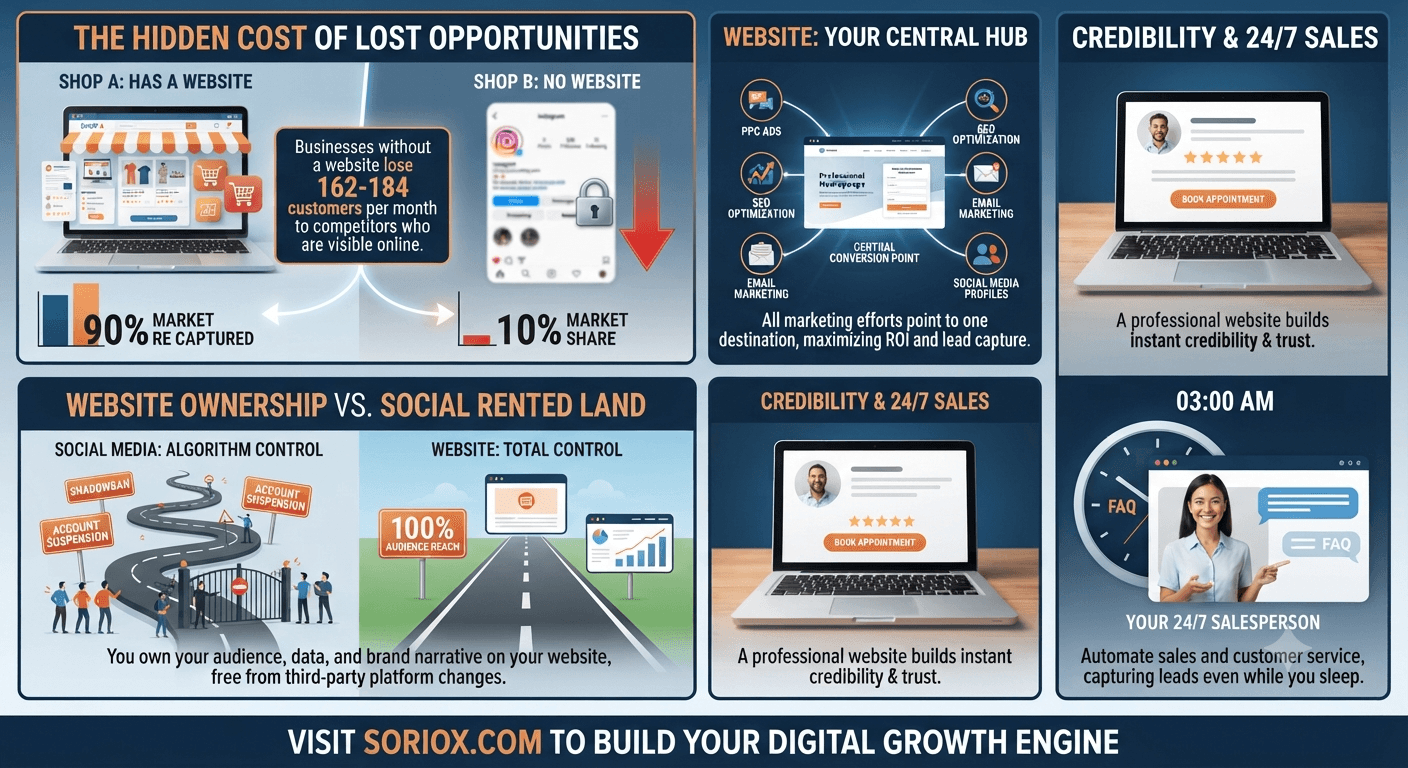
Result: You lose 162-184 customers/month to competitors with websites.
Over a year: 1944-2208 lost customers.
If your average customer value is $500: You’re leaving $972K-$1.104M on the table annually.
For a $2,000 transaction: $3.88M-$4.4M/year in lost revenue.
And this doesn’t even count:
- Lost repeat customers (no way to stay in touch)
- Lost referral chain (no “send them this link” option)
- Lost credibility (no online presence = appears illegitimate)
Real-World Example:
Two electronic product selling shops open in the same city.
Shop A: Has a website. Shows products, prices, photos, reviews, hours, location, online purchasing.
Shop B: No website. Only Instagram account with 2K followers (but only 100 people see each post due to algorithm limitations).
Customer searches “Rice cooker shop near me” on Google.
Shop A appears in Google Maps + local search. Gets the order.
Shop B? Invisible.
Shop A captures 90% of the online-search customers in month 1.
By month 6, Restaurant A is thriving. Restaurant B is struggling and closes.
Cost of no website? A business!
The Top Reasons Why Every Business Needs a Website
1. Act as the Central Hub for All Marketing Channels
Your website ties your entire marketing ecosystem together. Whether you publish a professional article, send an email newsletter, or run a targeted ad campaign, every single marketing effort should point back to your website, where the actual conversion takes place. Without it, your marketing channels have nowhere to send interested high-ticket prospects. Website captures leads by:
- Visitors from PPC Ads e.g. Google Ads → Website
- Visitors from SEO → Website
- Visitors from Email Marketing → Website
- Visitors from Social Media e.g. Facebook, Instagram, LinkedIn→ Website
- Visitors from search engines e.g. Google/Bing → Your website
2. Capture Intent-Driven Organic Search Traffic
- Social media feeds are built for quick engagement, but search engines are built for intent. When someone actively needs a solution, they turn to Google or AI-powered assistants.
- Through targeted Search Engine Optimization (SEO) and optimized service pages, your website acts as a 24/7 sales/clients engine for inbound leads.
- Unlike paid advertisements that stop running the moment your budget runs out, a well-optimized website compounds its value over time, driving organic traffic consistently.
3: Website vs. Social Media: Why You Can’t Rely On Social Alone
Problems with Social-Media-Only Strategy:
Suppose you’ve built 20K followers on Facebook, Instagram, and LinkedIn. You are getting comments, likes, and post engagement. Feels like you have a business online, right?
Wrong. The reality is different.
Social media platforms own your audience, not you. One algorithm change, one policy violation, one mass suspension wave—and your audience disappears.
The 3 Risks of Social-Media-Only:
Risk #1: Algorithm Dependency
Instagram organic reach is down to 5-10% for most business accounts. Translation: Only 1000-2,000 of your 80K followers see your posts. The rest? Shadow banned unless you pay for ads.
After Facebook’s algorithm changed in 2018, organic reach crashed from 15% to <3%. Thousands of businesses that had built followings lost their primary customer channel overnight.
TikTok algorithm is more vague. One day your videos get 10K views. The next day? 50 views. You have zero control.
Risk #2: Account Suspension (No Warning, No Appeal)
Your Instagram account gets flagged for “suspicious activity” (even if innocent). Suspended temporarily or permanently.
Your Facebook page gets reported by a competitor. Meta bans you without explanation. You have zero customer contact info. You’ve lost your audience.
Your TikTok violates a policy you didn’t know existed. Account gone. No way to reach your followers.
Meta, parent company of Facebook, officially says they ban, suspend, or disable hundreds of business pages every month, citing ‘Compliance issue’. When it does, they lose:
All customer contact info
All historical content
All audience relationships
All business credibility
And they have zero recourse.
Risk #3: Reach Decay Over Time
Even without suspension, platform reach decays naturally. Facebook saw a 50% organic reach decline from 2019 to 2023. LinkedIn changed its algorithm multiple times, killing reach for business pages. Twitter’s algorithm now prioritizes paid over organic.
Translation: Your 20K followers are becoming increasingly invisible. You’re paying more (in time or ads) for the same results.
The Website Advantage: Permanent & Full Ownership
When you own a website:
No algorithm controls your visibility: Your homepage looks the same for everyone
No account suspension risk: You control the platform; no third-party can ban you
All customer data is yours: You own emails, phone numbers, purchase history
Reach doesn’t decay: A 5-year-old blog post can still drive traffic today
You control the narrative: No platform policy limits what you can say/sell/do
The math:
Social media: 5-10% organic reach
Website blog: 100% reach to visitors (no algorithm gating)
4. Work Around the Clock as a 24/7 Sales Channel
Your physical storefront or office has closing hours, but your website never sleeps.
- It acts as your most reliable salesperson, greeting prospects at midnight, answering frequently asked questions, showcasing your catalog or portfolio, and capturing contact information via lead generation forms.
- Passive browsers are automatically guided down a structured conversion path, turning midnight interest into morning consultations and sales.
5. Maintain Complete Control Over Your Brand Asset
- Building your entire brand on rented land—such as social media platforms—exposes you to algorithm updates, reach decay, or sudden account restrictions.
- Your website is an asset that belongs entirely to you. You control the narrative, the visual identity, the custom typography, and the exact user journey without interference from third-party platform changes.
6. Establish Instant Credibility and Trust
When a potential customer hears about your business, what is the very first thing they do? They look you up online.
- If they find a clean, professionally designed website featuring your services, transparent information, and client testimonials, it signals that you are legitimate, established, and serious about what you do.
- If they find nothing—or only an outdated social media profile—doubt creeps in. A professional digital presence sets you apart from competitors and immediately builds confidence.
7. Deliver Essential Social Proof and Reviews
Consumers trust other consumers far more than traditional advertising.
- A dedicated website allows you to proudly display verified customer reviews, case studies, and portfolio galleries that validate your track record.
- This social proof reassures hesitant buyers and gives them the final push they need to make a purchase or book an appointment.
8. Gain Valuable Data and Audience Insights
Unlike offline word-of-mouth or traditional print advertising, a digital platform provides hard data.
- By integrating analytics, you can track how visitors find your site, which service pages attract the most attention, and where users drop off in the conversion funnel.
- These insights let you refine your marketing campaigns and make informed, data-driven decisions.
9. Expand Your Reach Beyond Local Borders
- If your business is physically bound to a specific city or region, a website tears down those boundaries, letting you target national and international markets across North America, Europe, and any region in the world.
- With properly structured localization and SEO, your business becomes discoverable to anyone around the world looking for your precise expertise.
10. Future-Proof Your Brand for AI and Voice Search
- The way people search for information has evolved dramatically. Modern buyers rely heavily on AI-driven searches like Google AI Overview, ChatGPT, Gemini, Perplexity, Claude, beyond typical Google search; Voice assistants (Alexa, Siri, Google Assistant); and semantic search engines.
- Businesses with well-structured websites featuring clear service descriptions, schema markup, and optimized content are actively cited by AI platforms and search engines. Without a site, you remain entirely invisible to these modern discovery channels.
11. Maximize Return on Investment (ROI)
- Far from being a costly expense, a professional website is one of the highest-return investments a business can make.
- By continuously generating inbound leads, building brand equity, and automating client acquisition, a well-built site pays for itself many times over compared to traditional, short-lived advertising models.
Where To Find A Good Website Design & Development Agency?
Now worry! We are here to help you design & develop a fast & responsive website for your business. Our expert Website Designers & Developers will build premium quality website for your business to revamp your digital storefront, implement robust e-commerce functionality, scale your inbound customer/client generation through advanced SEO.
To design & develop website for your business, contact us via:
WhatsApp: +880 1718 562578
Email: amir@soriox.com, contact@soriox.com
About Soriox
Soriox is a premier website design & development and digital marketing agency dedicated to helping businesses across the USA, UK, Canada, Australia, and the EU scale their digital footprint. We specialize in building high-performing, secure, and conversion-focused websites that turn casual visitors into loyal customers/clients. If you are ready to transform your online presence into a 24/7 lead-generation machine, connect with the experts at Soriox today to discuss your next project.